
Since I have been writing the Psalm sermon commentary for quite a few years now, I find that it seems like I have to write something for Psalm 80 every year. There’s a reason for that feeling: I have been writing on Psalm 80 every year during Advent because the Lectionary assigns it in Years A, B, and C (twice for the Fourth Sunday in Advent in Years A & C and once in Year B for the First Sunday in Advent). With only four Sundays in the Advent Season and given that there are 150 psalms to choose from, you have to wonder why one psalm gets used over and over.
Certainly there are a number of features to Psalm 80 that fit Advent. God is referred to early in the psalm as the true King of Israel who sits enthroned between the cherubim on the Mercy Seat atop the Ark of the Covenant. And in Matthew’s Gospel the Lectionary will shortly get to the Magi who correctly intuit from a special star that a new king had been born somewhere in Judea. Then there is near the end of the psalm a reference to the “son of man” and that title also is closely associated with Jesus in the New Testament.
But perhaps it is the thrice-repeated plea for God to restore God’s people and to make his face to shine upon them that most attracted the folks who came up with the Revised Common Lectionary. What is more associated with Christmas than the shining of lights? We deck out our Christmas trees with lights. We deck out whole neighborhoods with lights.
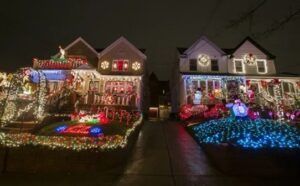
Biblically this is warranted. Think of Old Testament prophecies that ultimately anticipate the coming of God’s Messiah. Isaiah 60 famously gives us the line “Arise, shine, for your light has come!” When first the one angel and then the whole heavenly host of angels appear to the shepherds in Luke 2, we are told that the glory of the Lord shone all around them. The Magi found their way to baby King Jesus because of the shining of a star in the night sky. Although it is very hard to understand precisely what Luke meant by saying that eventually that star came to rest on the place where Jesus was (how exactly does a star “rest” on a specific spot?), nevertheless it was the light that led the Magi to just the right place at just the right time.
As I have noted in past commentaries—and again, you get Psalm 80 every Advent in the Lectionary—there is no missing in Psalm 80 the echo of the Aaronic Benediction in Numbers 6. That blessing is probably the most oft-heard benediction around the world in various languages every Sunday. Perhaps no single blessing has been spoken over the whole course of Judeo-Christian history than that one.
But it is important to note that this petition for God to make his face to shine upon his people does not in Psalm 80 come as the capper to some lovely and inspiring worship service as we may hear it in church on any given Sunday. Instead the request for God to shine emerges from a context of suffering, of disorientation, of apparent abandonment by the very God being addressed in this psalm. The setting here is a far cry from hearing this blessing spoken at the end of a lovely Christmas Eve Candlelight service that warmed the cockles of every heart in the sanctuary. Rather Psalm 80 is an intense cry from a somewhat chaotic context.
Not only is this setting important to understand Psalm 80 aright, it is also the best way to see how and why Psalm 80 fits Advent and Christmas today yet as well. Because even 2,000 years after that star led the Magi along and even though Jesus overtly went on to proclaim himself the Light of the World in John’s Gospel, the darkness of sin and evil have had a way of hanging in there in this world all these millennia later. Recently when recording a podcast / radio program I co-host we noted the irony that Jesus’s saying “I am the Light of the World” in John 8 emerged near the end of one of the most contentious chapters in the New Testament. Jesus and his religious opponents sparred endlessly in that chapter and by the time it was done, the religious leaders called no less than the Son of God the devil himself.
We like to rarify the “I Am” sayings in John’s Gospel and treat them as free-floating lovely declarations suitable for framing in a counted-cross-stitch wall hanging. But that’s not where the sayings came from. “I am the resurrection and the life” was spoken to people who were weeping and wailing over Lazarus’s death. And the Light of the World saying also emerged from a fraught and taut moment in Jesus’s ministry.
But those were precisely the moments that needed those sayings. And similarly the chaotic disorientation of the Israelites as reflected in Psalm 80 was precisely the setting from which the people needed to ask God to shine the light of his face upon them. It’s no different today, of course, as we wrap up Advent 2025 and prepare once more to celebrate the birth of all hope. The world feels to many of us about as dark as it’s ever been as wars rage endlessly and as many societies seem to be rattling apart over partisan divides so fierce they have in recent times literally led to acts of horrendous violence.
It is somewhat ironic that the RCL would have us pass over verses 8-16. Those are the parts of Psalm 80 that most vividly describe the sorry state of affairs in Israel. These are the verses that spell out why the people so desperately need God’s face to shine upon them. We’d best actually not delete these stanzas. But similarly in the church during Advent and Christmas: we might be tempted to edit out the sad and scary headlines of the day so as to make room for as much so-called “Christmas cheer” as we can.
But as preachers let’s not do that. Let’s let the congregation remember full well the surrounding darkness and chaos of sin and evil. Because only then when we ask the Light of the World to shine upon us can we do so with all the hopeful desperation we need. The light of Christ that shines at Christmas is not just pretty, it’s not primarily cozy. Rather it is our only hope precisely because the world is so full of shadows. Let the light of Christ shine in that context and we will never fail to remember for a moment why this is the heart of the Good News that just is the Gospel of Jesus Christ our Lord.
Note: In addition to our weekly sermon commentaries each Monday, check out our special Advent and Christmas Resource page for more sermon ideas and other Advent/Christmas resources.
Illustration Idea
For quite a few summers some years back I had the privilege of co-leading a week-long “From Text to Sermon” seminar with the outstanding Bible commentator and teacher Frederick Dale Bruner. During those years Dale was working on his commentary on John’s Gospel and so we spent those weeks camped out in that fourth Gospel. We always began the seminar where John begins: in the prologue of John 1:1-18. Dale had memorized his own slightly embellished version of these verses and did a recitation of it for the group each summer.
When he got to verse 5, he would say with great drama, “The light shinesssssssssss in the darkness.” He stretched out the “s” at the end of “shines” to emphasize its ongoing present tense. It’s not that the light once shined. It’s not that the light will shine in the future. It is instead a light whose shining is right now and forever. It will never stop shining. And since the darkness is still very much with us, as news goes, that present-tense shining is very good news indeed.
Dive Deeper
This Week:

Spark Inspiration:


Sign Up for Our Newsletter!
Insights on preaching and sermon ideas, straight to your inbox. Delivered Weekly!
Sermon Commentary for Sunday, December 21, 2025
Psalm 80:1-7, 17-19 Commentary