
At a conference I attended recently, a woman who works as a psychologist and counselor addressed the topic of trauma in conversation with the Book of Psalms. She related a story from decades ago when her then-boyfriend became paralyzed following a devastating biking accident. In the midst of her grief and sorrow over this turn of events, she was confronted with Psalm 121. A psalm that is meant to be comforting and reassuring became instead a string of verses that only added to the trauma she was experiencing. Because the psalm makes it clear God watches over us and God does so diligently. He will not let our feet slip. Yet in a sense her boyfriend’s feet and whole body had slipped, had fallen. The issues and emotions and questions that Psalm 121 raised at that moment made this woman feel worse, not better, for having read this song.
Most assuredly her reception of Psalm 121 at a terrible moment is not unique. Probably people who are in distress and sorrow have this reaction to this and other similar psalms a lot. What’s more, we are reading this in the context of the Season of Lent. The whole point of this liturgical time in the Church Year is to reflect on how the Son of God incarnate was also permitted to have his feet slip. A lot. He was falsely accused and then physically abused. He was jeered at and mocked. He was spit upon and hit repeatedly on the head. And then as a way to finish the whole sordid business off, he got crucified. And all of this was happening under the watchful gaze of the One Jesus called “Father,” the One who in Psalm 121 is depicted as not letting harm come anywhere near his people.
So how are we to take this well-known psalm? How do we understand this oft-called “Traveler’s Psalm” since it may have been written for the people of Israel while on a pilgrimage to Jerusalem and is sometimes read for family devotions at the dinner table the evening before a planned vacation trip? To begin, let’s unpack a bit of the psalm itself before returning to these acute pastoral questions.
It has been noted in past sermon commentaries on the CEP website that the opening verse presents a curious scenario. Older translations—ones that many of us of a certain age can remember hearing read in church or at the dinner table—presented verse 1 as a declarative statement. “I lift up mine eyes to the hills, whence cometh my help.” Translated this way the hills are depicted as the source of the psalmist’s help.
More recent translations render the end of verse 1 as a question: “I lift up my eyes to the mountains—where does my help come from?” You could almost insert the word “but” in there to make it clearer; “I lift up my eyes to the mountains BUT where does my help come from?” Rendered this way the mountains raise the question of where the psalmist’s help comes from but in this case and in a completely opposite meaning of the older translations, the help is most certainly not up in the mountains. And why might that be? Because some commentators now believe that the hills or mountains represent those “high places” where the Canaanites once built their shrines to Baal and Asherah. Israel had been mandated to dismantle all such pagan altars in the high places but we know from history they did not do so. Not all of them at least.
In that case, glancing upward revealed the false religions of the day, the false sources for help, protection, or deliverance. So in the opening verse the psalmist rejects those fake sources for help and opts instead for the Maker of heaven and earth and of all those very mountains. In short, Israel’s true God Yahweh. This God is our truest help because this God watches over us at all times. For people on a journey, it was good to know feet won’t slip, ankles won’t get twisted, legs won’t get broken. It’s good to know God is a shade from the rays of the sun and a protection from the “lunacy” ancient peoples feared could be caused by the light of the moon. Indeed, God will protect us from all harm and is mindful of all the busy comings and goings of our lives.
It’s all lovely, it’s all lyric, it’s all set to become a comforting counted-cross-stitch wall hanging with which to decorate the living room.
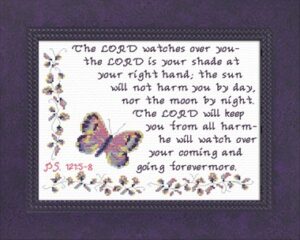
But then there are those confounding pastoral questions that invariably come up when harm does come, when feet do slip. What are we preachers and pastors and counselors to say then? Well, we can always make some manner of recourse to saying that songs like this in the Psalter are aspirational, are going to be true in the longest possible run. For now bad things happen and if we cannot always know the reasons why—perhaps we seldom actually know the reasons why—what we can say is that those tragedies and accidents do not remove us from our heavenly Father’s care. Psalm 121 still expresses God’s ultimate hope and intentions and even if we have to try to take comfort in that in the midst of sorrows, this truth abides. This answers none of people’s more acute questions but it is not an empty or hollow hope to hang onto even so.
But then there is the Lenten connection to all this as assigned for the Year A Season of Lent in the Lectionary. This adds a new pastoral dimension because we see A) that Jesus also underwent events that seem to be the polar opposite of Psalm 121 and therefore B) Jesus has firsthand knowledge of what we experience and so has enormous compassion and empathy for us when we pass through trials. The New Testament makes it clear that Jesus is able fully to sympathize with us in our trials, temptations and sorrows. He has been there himself. Recently Jared Ayers published a book (that I confess I have not yet read) with the provocative title You Can Trust a God with Scars. And that’s just right and perhaps a good bottom line for how to read, understand, and preach on the 121st psalm.
[Note: For the Year A Season of Lent and leading up to Easter, CEP has, in addition to these weekly sermon commentaries, a special Lent and Easter Resource Page with links to whole sermons, commentary on Lenten texts, and more.]
Illustration Idea
All through history it seems people have associated high places, high hills, high mountains with finding truth or maybe even nearness to the divine. Even biblically whenever we see characters going up a mountain, it seems likely an encounter with God is imminent. Think of Abraham on Mount Moriah, Moses on Mount Sinai, Jesus and the disciples on the Mount of Olives at the Transfiguration. But we’ve also seen many cartoons of people arriving at the top of a mountain only to encounter some spiritual guru sitting with legs crossed and prepared to dispense advice and revelations. Back in the 1960s when The Beatles were in India to spend time with the yogi known as the Maharishi, they had an opportunity for one of them to go on a helicopter ride with the Maharishi. John Lennon jumped at the chance and so up he went. Later Paul McCartney asked his bandmate why he had been so eager to do that and Lennon replied, “I thought while we were up there he might slip me the answer.”
The Answer. Getting in touch with the ultimate reality of all things. Sometimes we see billboards that say “Jesus Is the Answer” (which always prompts a friend of mine to cry out, “But what was the question!!??”)
Psalm 121 is also about finding the answer, finding the truest source for help and hope and protection. And we find it in the Lord God of Israel, in the Father, Son, and Holy Spirit of the holy Trinity, in the carpenter’s Son from Nazareth who is our crucified and risen Lord and God and Savior. He is our help when things run smoothly in life but also when the bottom drops out for whatever the reason.
Dive Deeper
This Week:

Spark Inspiration:


Sign Up for Our Newsletter!
Insights on preaching and sermon ideas, straight to your inbox. Delivered Weekly!
Sermon Commentary for Sunday, March 1, 2026
Psalm 121 Commentary